Showing posts with label Lincoln and Race. Show all posts

Friday, March 13, 2009

Lincoln Symposium at the Library of Congress

On March 4, the Library of Congress sponsored a symposium on Abraham Lincoln, held in conjunction with their fantastic bicentennial exhibition "With Malice Toward None" (which I will overview in an upcoming entry). The symposium, held on the 148th anniversary of Lincoln's first inauguration (and, though unsaid, the 144th anniversary of Lincoln's second inauguration), featured six lectures, mostly focusing on aspects directly related to Lincoln's presidency.

I was fortunate to attend the lectures, held in the Coolidge Auditorium in the basement of the Jefferson Building. While the room was warm and there weren't long enough breaks (leading to information overload by the end of the day), the audience was large and rightfully appreciative of the speakers, who offered mostly excellent and accessible remarks.

Yesterday, the Library of Congress uploaded the lectures onto the webcast section of their website, meaning that you can listen to any or all of them -- total running time with introductions and questions is 320 minutes. The first three lectures (Holzer, McPherson, Miller) are here; the second three (Morel, Wilson, Leonard) are here. [Until I attended the symposium, I had no idea that the Library of Congress was putting such things online. Kudos to them for embracing the technology and broadening the reach of the Library's programming.]

While the six lectures were on a variety of themes, it was surprising how there were similar undercurrents throughout several, and occasionally all, of the talks. Race was a key issue in all of the talks in one way or another, owing to the persistent questions about whether Lincoln was a racist throughout his life. Another consistent theme was Lincoln's determined self-improvement: whether learning to be commander in chief, or carefully crafting his messages and speeches, Lincoln was persistent in his attempts to become more capable at his tasks. The most surprising thread through the day was the repeated focus -- and repeated quoting -- of Lincoln's 1854 speech at Peoria, debating Stephen Douglas on the rationale for the Kansas-Nebraska Act. Evidently Lewis Lehrman's recent book, Lincoln at Peoria, is much more influential than I had realized.

A synopsis of the six lectures follows, with highlights of things that piqued my interest in the various talks.

Harold Holzer, co-chair of the Lincoln Bicentennial Commission and author or editor of multiple Lincoln books, led off the symposium with the day's most polished lecture, "Lincoln Comes to Washington: The Journey of a President-Elect." Drawn from his newest monograph, Lincoln President-Elect, Holzer presented a balanced lecture of fact, analysis, and colorful anecdotes. He centered his remarks on an extended look at Lincoln's Farewell Address, given to his neighbors at the train station in Springfield on February 11 when he boarded his train to Washington DC.

In perhaps his most interesting point, Holzer paid particular attention to how Lincoln compares himself to Washington: "Today I leave you; I go to assume a task more difficult than that which devolved upon General Washington." Such a blatant equal comparison to Washington was highly unusual, if not almost impolitic at the time. Holzer carefully showed that it's inclusion in these unplanned remarks was not accidental, given that Lincoln uses variations of the comparison in later speeches along his journey from Springfield to Washington. The larger implications of this dramatic comparison, where Lincoln suggests he might be Washington's equal rather than merely his successor, were left unexplored, owing to time constraints and the otherwise general nature of the enjoyable lecture.

Pulitzer-Prize winning historian James McPherson followed with a talk on "Abraham Lincoln as Commander in Chief," no doubt drawn from McPherson's recent Lincoln Prize-winner, Tried by War: Abraham Lincoln as Commander in Chief. McPherson, a noted military historian, explained that Lincoln had four roles as Commander in Chief: 1) to raise and equip the military, 2) to oversee political strategy related to the war, 3) to oversee military strategy, and 4) to oversee operational strategy. Of these, McPherson was most interested in the fourth, which involved Lincoln planning how to implement his general military strategy through battle campaigns (something modern presidents generally leave to the military leaders). Noting that Lincoln was inexperienced and uneducated about the military before becoming president, McPherson noted how his study of military affairs and tactics led to his evolving skills as a military leader.

Given McPherson's obvious interest in Lincoln's unexpected involvement in military operations, it is curious that he spent little energy comparing Lincoln to his Confederate counterpart Jefferson Davis, who was educated at West Point and had served as Secretary of War. At the war's outset, it was thought Davis might actively lead the Confederate Army as a general in the field; still, he was an active commander in chief too, but of a very different model than Lincoln.

William Lee Miller, author of Lincoln's Virtues and President Lincoln: The Duty of a Statesman offered a reflection of the comparison between Presidents Lincoln and Obama in his lecture "A New Birth of Freedom." Unlike the preceding talks, Miller's was obviously written specifically for the symposium, and included observations from Obama's inauguration and the bicentennial celebration just three weeks before. The talk was filled with examples of Miller's quick wit and sense of irony, as well as his intellectual curiosity. As many others have, he reflected on how Obama's election fulfills the promise of Lincoln's Emancipation Proclamation and his subsequent support for plans to allow black soldiers to vote. He tied this observation to an argument from his latest book about how the Emancipation Proclamation was more significant morally than legally.

After lunch, Lucas Morel, author of Lincoln's Sacred Effort: Defining Religion's Role in American Self-Government, spoke on "Lincoln on Race, Equality, and the Spirit of '76." The talk served as an exploration of Lincoln's views on race, which recently have received a great deal of scrutiny. Unlike some scholars, Morel defended Lincoln's views on race, arguing that they were progressive. In fact, contrary to those who see some of Lincoln's statements on race as proof of racism, Morel argued that "even his most extreme comments" were meant to nudge his racist audience toward accepting a form of natural equality, like the one implied by the Declaration of Independence. To defend this argument, Morel pointed to Lincoln's "hesitancy" when speaking about race throughout his career, which is certainly an interesting approach to Lincoln.

Douglas Wilson, who spent years co-editing the definitive collection of Herndon's interviews, has recently turned his attention to Lincoln the writer. In his talk, "Words Fitly Spoken: Lincoln and Language," Wilson focused on Lincoln the careful re-writer and editor in preparing his speeches, an extension of his recent study, Lincoln's Sword: The Presidency and the Power of Words. Unlike that book, which focuses on the presidential years (and Lincoln's Farewell Address in Springfield), Wilson turned his attention to pre-presidential speeches, but saw the same careful editing from draft to finished product.

Finishing out the day was Elizabeth Leonard, author of Lincoln's Avengers: Justice, Revenge, and Reunion After the Civil War, who spoke on "Ally on the Team of Rivals: Lincoln and His Point Man for Military Justice." Leonard spoke about Joseph Holt, the Kentucky Democrat who became Lincoln's Judge Advocate General in late 1862 and who worked beside Lincoln on issues of pardons in military cases. This was the afternoon's least polished talk, an exploration of Holt's biography, that suggests Leonard is still assimilating her research. While I was unconvinced by her argument -- she twice asked why Holt allied with Lincoln and never gave a satisfying answer -- I was convinced that she could develop a new biography of Holt or a book about the Lincoln/Holt professional relationship.

Wednesday, February 25, 2009

TV Review: "Looking for Lincoln" (PBS)

Toward the end of Henry Louis Gates Jr.'s excellent exploration "Looking for Lincoln," the African-American scholar admits that his examination of Abraham Lincoln had challenged his cherished image of The Great Emancipator. "It's been deeply disappointing to me to learn that Lincoln came to emancipation slowly," Gates laments, "and that he questioned even the basic assumption of the equality of the races."

Then he sits with noted Lincoln biographer Doris Kearns Goodwin, evidently a personal friend (likely given that both historians live in Boston), and has a remarkable exchange with her reflecting on how troubling it was to discover Lincoln's prejudicial attitudes toward race, even as he praises Lincoln's political skill in his actions involving emancipation and racial issues, because of his status within the African-American community as the white man who made civil rights possible.

"Do you know what's so interesting, Skip, in listening to you talk? The problem is not your understanding of what was possible for Lincoln; the problem is the infatuation, the myth, that Lincoln was presented in the first place to you," Goodwin says, getting emotional. "It's not Lincoln's fault that he got mythologized...And I think to just bring him down now to the human being, with his strengths and his weaknesses -- if you could feel that as well as you're saying it, I think you would feel more empathy for him."

"No, but you're right," Gates responds, "it's clear that I don't feel it. I can think it, I can understand it--"

"Exactly," Goodwin affirms over him, "that's what I'm feeling," and suddenly stopping to let him continue, can't finish her thought -- that's what I'm feeling you're feeling.

In the middle of a documentary attempting to detect the historical facts about Lincoln, a discussion about feelings between two historians who are obviously emotionally involved in their study of the sixteenth president. More than that, though, this extraordinary exchange represents the crux of the Lincoln myth -- Americans are as emotionally attached to the iconic Abraham Lincoln as they are intellectual attached, if not more so.

Though I am not an African-American, I know Gates' disappointment with Lincoln firsthand, having gone through my own de-mythologizing of Lincoln several years ago. For a couple of years, I didn't like the man who I discovered was not an idealist but always a practical politician. Worse, he was a rather ruthless partisan hack in his early days, and those skills never faded away, even though his attitude did. (Eventually, I gained a great appreciation for how Lincoln ultimately used his political skills.)

"Looking for Lincoln," a PBS production, is less a documentary than a two-hour visual essay by Gates, a Harvard professor of African-American Studies. Gates intercuts his cross-country travels looking for Lincoln the icon with a mostly chronological presentation of the historical Lincoln. The film moves a good clip, though it never feels rushed, covering lots of ground; Gates interviews a dozen scholars, two former presidents, and others. He visits with Lincoln presenters (people who dress up like Lincoln), and descendants of Confederate veterans who strongly dislike Lincoln. He walks the Gettysburg battlefield, visits the Soldier's Home where Lincoln probably wrote the Emancipation Proclamation. He sits in on a high school discussion about Lincoln in Chicago.

Along the way, Gates struggles to present the personal complexity of Abraham Lincoln, as opposed to the marble icon of the Lincoln Memorial. Most often he focuses on the complexity of Lincoln's racial views, which is understandable given his other research on race in the United States.

The film is a great success, owing to Gates unstinting honesty and his skills as both a historian and a storyteller. Most people will learn a lot about Lincoln and will be forced to think directly about how Lincoln the man relates to Lincoln the myth. If the film has any flaw, it is that Gates' conclusion is a bit underwhelming, but the strength of the film makes up for that.

"Looking for Lincoln" premiered on PBS on Wednesday, February 11, 2009.

Tuesday, February 10, 2009

New Lincoln Books This Week

While most of the high-profile books hoping to cash in on the Lincoln bicentennial have been released steadily over the past few weeks, there are still two significant new offerings this week. Both published from university presses, one is yet another companion book to a Lincoln exhibit and the other is a new volume on Lincoln and slavery.

Releasing on February 10

The Tsar and the President: Alexander II and Abraham Lincoln: Liberator and Emancipator edited by Marilyn Pfeifer Swezey (University of Wisconsin Press, 2009, paperback, 112 pages)

This book is a companion to a traveling exposition, "The Tsar and the President," which premiered last year at The Oshkosh Public Museum and currently is on display at the Kansas City Union Station Museum. The display attempts to compare the life of the two great liberators of the mid-19th Century, Tsar Alexander II of Russia, who outlawed serfdom in 1861, and President Abraham Lincoln of the United States, who famously signed the Emancipation Proclamation January 1, 1863 and worked to ensure the passage of the 13th Amendment.

The two men were very different. Alexander was well educated; Lincoln received little formal education. Alexander was raised in the elite, ruling class; Lincoln grew up poor and scraped his way into relative financial comfort. Both, interestingly, were assassinated: Lincoln in 1865 and Alexander in 1881. But they are both remembered most for their emancipation decisions.

This is an intriguing comparison, if only because it rightly suggests that the slavery issue was not unique to the United States. Indeed, in ways that have probably deserve more significant study, abolitionism was an international movement; it might be easy to exaggerate its influence, but it is important to understand that the conflict over slavery/serfdom was not only an internal issue in either the US or Russia.

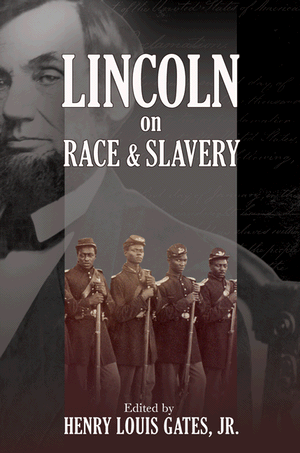
Lincoln on Race and Slavery edited by Henry Louis Gates, Jr., and Donald Yacovone (Princeton University Press, 2009, hardcover, 408 pages)

This book presents Lincoln's own words on race and slavery, offered during his life in speeches and letters. Bringing together seventy pieces that Lincoln wrote during his lifetime -- from his protest as an Illinois legislator against slavery in 1837 to his final public address on three days before his assassination in 1865 -- the book offers an introduction for each selection in addition to a general introduction by Gates.

This collection seems to mostly repackage material available in many other Lincoln anthologies. However, for someone particularly interested in this subject, the editorial context offered by the noted African-American scholar Henry Louis Gates might make this book worth owning.

Friday, January 30, 2009

Lincoln Bicentennial Articles

The obligatory articles about the meaning of Abraham Lincoln in American history have started appearing. The next is in this weekends USA Weekend supplement. Featuring the hyperbole that USA Today (McNews) is famous for -- here calling Presidential historian Michael Beschloss "America's foremost historian"* -- the cover article (whatever that's worth in USA Weekend) is still worth a look.


All seven of Beschloss' points is accurate, and I'm not sure what I would add. But I was most intrigued by #4 "[Lincoln] helped pioneer modern race relations." This is a very interesting way to put it. While Beschloss points to the legacy of emancipation, perhaps Lincoln should also be recognized for the way that his own treatment of African-Americans developed, especially during his presidency. Here was a man who was uncomfortable about the race issue, as opposed to the slavery issue, but who refused to allow his discomfort to prevent him from dealing with African-Americans (like Frederick Douglass) face-to-face. Part of this was political savvy -- he needed Douglass' standing among freed Blacks -- but part of it, I think, was his recognition that separating the races (via colonization) would never occur, and that he, just as a person, needed to learn how to live beside freed Blacks. Lincoln didn't always say the right things; he never completely lost his white supremacist viewpoint (a relic of his upbringing). But he refused to be a prisoner of his past, and he acted more often with charity towards others than with fear. In some ways, that could describe race relations in the United States for the last fifty years.

*By the way, I'm not sure who America's foremost historian is currently. Until his death, it was probably Arthur Schlesinger, Jr. Popularly speaking, it might be David McCullough -- might be. But by any yardstick, Beschloss, respected historian that he is, should never be described as America's foremost historian.