Showing posts with label New Lincoln Books. Show all posts

Wednesday, September 29, 2010

New Lincoln Book

A new Lincoln-related book was released today, the second recent book focusing on the 1860 presidential election, which was a wild free-for-all, with no fewer than a dozen serious candidates for nominations and four candidates in the November election.

Year of Meteors: Stephen Douglas, Abraham Lincoln, and the Election that Brought on the Civil War by Douglas R. Egerton (Bloomsbury Press, hardcover, 416 pages)

Doris Kearns Goodwin's prize-winning Team of Rivals revealed to many that Lincoln faced several better known Republicans for the 1860 presidential nomination, before inviting several of them to serve in his cabinet after his election. It should come as no surprise that the Democratic nomination was just as fiercely contested -- so much so that the party actually split into regional factions, each nominating a candidate. Steven Douglas, who had worked tirelessly over the past decade to position himself as the front-runner (including his assertive chairmanship on the Senate committee on territories), had positioned himself as the only Democrat acceptable to both North and South, only to discover that he wasn't acceptable to both regions either.

This book has only gotten a couple of reviews today, but one is in The Wall Street Journal. It seems that Egerton focuses more on Douglas than Lincoln, which certainly is an accurate portrayal of the year 1860 -- Lincoln won the election, but Douglas was the central personality of the year.

John Waugh's Reelecting Lincoln offers an entertaining portrayal of the 1864 election. The 1860 contest was much more action packed, with plenty of tension and lots of big personalities. So Egerton has plenty of material to work with -- here's hoping that he does it justice.

Thursday, November 12, 2009

New Lincoln Books This Month

In the past few weeks, there have been a few Lincoln-related books released. Two are new hardcovers, two are new paperback editions of previously published books. Among them are a new collection of Lincoln photographs, an study of Lincoln's use of religious language, a dual biography of Lincoln and Frederick Douglass, and a book on the assassination.

Lincoln, Life-Size by Philip B. Kunhardt III, Peter W. Kunhardt, and Peter W. Kunhardt Jr. (Knopf, 2009, hardcover, 208 pages)

The Kunhardts, including the late Peter W. Kunhardt Jr., are documentary film producers and authors, who occasionally publish books related to their larger projects. This is their third Lincoln book, following Lincoln (1992), which was a companion to an ABC documentary, and this year's "Looking for Lincoln."

The thought behind this book is to take known photographs of Lincoln, including some pictures where Lincoln is only one person among many, and then to blow up Lincoln's face to life-size dimensions. It is an intriguing idea. Lincoln's face is very expressive in an odd sort of way, and there are so many images of Lincoln that the comparisons between them must be very interesting. My only concern is that some of these blown up images must be pretty blurry and grainy; otherwise, it sounds like an intriguing experiment that might offer new appreciation for Lincoln from the abundant photographs taken during his lifetime.

Lincoln's Gettysburg Address: Echoes of the Bible and Book of Common Prayer by A. E. Elmore (Southern Illinois University Press, 2009, hardcover, 280 pages)

Several books have been written about Lincoln's Gettysburg Address, including the recent The Gettysburg Gospel by Gabor Boritt and Gary Wills' Pulitzer Prize-winning Lincoln at Gettysburg. In both of these books and others, authors have rightly commented on Lincoln's use of religious imagery and language. None, to my knowledge, has focused only on the religious language until this book by A. E. Elmore, a professor of English at Athens State University in Alabama.

Such a study is long overdue. As significant as Wills' book is, with its effort to contextualize the address within its situational context -- including his fascinating presentation of the relationship of Lincoln's words to the nascent pastoral movement in cemetery design, he only devotes only one chapter to the words of the address itself. A careful consideration of the antecedents of the words, so many of which have complex layers of meaning, can only improve appreciation of Lincoln's careful use of language.

Giants: The Parallel Lives of Frederick Douglass and Abraham Lincoln by John Stauffer (Twelve, paperback, 448 pages)

The relationship between Lincoln and Douglass, often contentious given some of Douglass' writing about Lincoln during his administration, is most often remembered for Lincoln soliciting "my good friend Douglass'" opinion of his second inaugural address. ("A sacred effort," Douglass is reported to have replied.) However, the relationship was much more complicated, partially because both Lincoln and Douglass were self-made men who were best known for their ideas.

On the other hand, this is one of three recent books that have focused on Lincoln and Douglass. The relationship is intriguing, if only that Douglass' 1876 address about Lincoln at the dedication of the Freedman's Memorial may be the most honest assessment from any of his contemporaries. But three books in the past five years? Probably overkill. Having not read any of the three, I do not know which one should be read.

"They Have Killed Papa Dead!": The Road to Ford's Theatre, Abraham Lincoln's Murder, and the Rage for Vengeance by Anthony S. Pitch (Steerforth, paperback, 560 pages)

If there are too many books about Abraham Lincoln and Frederick Douglass, there are certainly too many about the Lincoln assassination. The interesting thing here is that Pitch has been a longtime Washington DC area tour guide, even appearing on C-SPAN, describing the events surrounding the assassination at their original location.

As such, I have no doubt that Pitch has an ear for the right way to tell the story, and I imagine that he has a wealth of stories to tell after his many years (given the 560 pages of the book, it appears that indeed he does have a wealth of stories). Will this book rival Blood on the Moon by Edward Steers Jr. as a must-have volume? Hard to say. It probably will be most interesting for serious students of the assassination looking for even more stories and details surrounding the tragic event.

Friday, October 9, 2009

Recent New Lincoln Books

Three books about Abraham Lincoln have been released in the past few days. One is a new volume; one is a reissue of a book out of print for decades; and one is a paperback issue of a recent bestseller.

Tried by War: Abraham Lincoln as Commander in Chief by James M. McPherson (Penguin, 2009, paperback, 352 pages)

McPherson is justly famous for his Pulitzer-Prize winning Battle Cry of Freedom, his one-volume history of the Civil War. Before and since, he has often written military histories about the war, including a well-received book on the Battle of Antietam.

Now the Civil War military historian turns his attention to the question of Lincoln's military leadership during the war. Given how central this was to Lincoln's presidency, it is amazing how poor the scholarship on this aspect of Lincoln's leadership has been over the years. One hopes that McPherson is successful in drawing more consistent and learned attention to Lincoln as commander in chief. And it is certainly a book that serious students of the Civil War have been awaiting.

Lincoln under Enemy Fire: The Complete Account of His Experiences during Early's Attack on Washington by John Henry Cramer, with an Introduction by Charles M. Hubbard (University of Tennessee Press, 2009), hardcover

This book, a reissue of the 1948 edition with a new introduction, sorts through all of the eyewitness testimony regarding Lincoln watching the 1864 battle at Fort Stevens on the northern outskirts of Washington. Cramer, a historian at what was then Youngstown College (now Youngstown State University) carefully recreates the most likely events surrounding how Lincoln came directly under enemy fire that summer day.

In some ways, this was the most audacious story of the war, with an American president voluntarily traveling toward a battle already in progress to see firsthand what was going on. A clear account of what happened surrounding that event is a worthwhile addition to the Lincoln bookshelf.

Walking with Lincoln: Spiritual Strength from America's Favorite President by Thomas Freiling (Revell, 2009), hardcover, 224 pages

This book seems to be an odd mixture of a religious daily devotional with Abraham Lincoln. Judging by an excerpt available online, Freiling combines stories about Lincoln, words by Lincoln, and Bible passages, covering fifty spiritual principles one can draw from Lincoln's example.

I am always fearful when someone writes about Lincoln's religious faith or example. The issues surrounding that debate are enormously complicated, owing to the fact that much of the evidence is anecdotal and second- or third-hand, meaning that some of it is highly suspect. Still, it appears from the introduction that Freiling is aware of this and refrains from claiming too much about Lincoln's religious beliefs. The devotional is an interesting genre for a Lincoln book, but given the complexity of the issue, might be wiser than a more traditional biography.

Tuesday, May 12, 2009

New Lincoln Books This Week

There are two Lincoln-related books set to be released this week.  One is yet another collection of Lincoln's speeches and writings.  The other is not specifically about Lincoln, but claims to reclaim a misunderstood part of Lincoln's legacy in a new examination of the impeachment of Lincoln's successor, Andrew Johnson.

The Essential Lincoln: Speeches and Correspondence edited by Orville Vernon Burton (Hill and Wang, 2009, hardcover, 192 pages)

Vernon Burton, a professor of history and sociology at the University of Illinois, was overlooked for his recent book about Lincoln and the Civil War era, The Age of Lincoln (2007), an audacious book that sought to be a sequel of sorts to Arthur Schlesinger's Pulitzer Prize-winning The Age of Jackson (which, astonishingly, had been Schlesinger's bachelor's thesis at Harvard).  That book received only limited attention, though the few reviews noted Burton's clear writing style.

Now Burton unveils a collection of Lincoln's writing, with introduction and notes.  The publication announcement promises that the Cooper Union Address, the 1862 letter to Horace Greeley (with the famous "if I could save the Union" by freeing no, some, or all slaves), the Gettysburg Address, and the Second Inaugural.  Other selections are "skillfully edited down," including pieces of the Lincoln-Douglas debates -- understandably -- and the Emancipation -- less understandably, except that most people find it rather boring.  The Macmillan website (Hill and Wang is a publishing house within the larger company) lists 29 included selections.

This collection likely falls short of other compilations of Lincoln's words, including the classic The Living Lincoln by Paul Angle and the two-volume Library of America collection (although there is also a single paperback "Selections" edition from the Library of America), given the few selections included.  

Impeached: The Trial of President Andrew Johnson and the Fight for Lincoln's Legacy by David O. Stewart (Simon & Schuster, 2009, hardcover, 464 pages)

David O. Stewart is a lawyer turned author, who has written his second book.  The first, a new account of the Constitutional Convention of 1787, was relatively well received.  The second promises to be intriguing, at least to students of Lincoln.

Even though Stewart's focus is on the impeachment and Senate trial of Andrew Johnson, the press notes suggest that he is arguing for a radical reconsideration of the mantle of Lincoln in this trial.  He suggests that most historians believe that Johnson was impeached for trying to preserve Lincoln's goal of a lenient reconstruction, Stewart evidently claims that it is the Radical Republicans who are the true heirs of Lincoln's legacy.

From Stewart's website:
Impeached challenges the traditional version of this pivotal moment in American history, which portrays Johnson as pursuing Lincoln's legacy by showing leniency to the former rebels.   Impeached shows the compelling reasons to remove this unfortunate president from office, reveals the corrupt bargains that saved Johnson's job by a single senator's vote, and credits Johnson prosecutor's with seeking to remake the nation to accord with the ideals that Lincoln championed and that the Civil War was fought for.
This certainly is a unique interpretation of the Republicans in Congress, who had a rather contentious relationship with Lincoln while he was alive.  On the other hand, it is certainly clear that many sides fought to claim Lincoln's mantle to justify their positions.  As such, this book has the potential to shift understanding of the fight for Lincoln's legacy in the years immediately following his death.

Thursday, April 16, 2009

New Lincoln Books This Week

There are a couple of Lincoln books being released this week, though neither of them should be classified  as new.  The first is the 50th anniversary edition of a classic book about the Lincoln-Douglas Debates, and the second is yet another collection of Lincoln quotations.

Releasing April 15

Crisis of the House Divided: An Interpretation of the Issues in the Lincoln-Douglas Debates, 50th Anniversary Edition by Harry V. Jaffa (University of Chicago Press, 2009, paperback, 472 pages)

As the bicentennial celebration of Abraham Lincoln's birth continues, it can be difficult to imagine that the Abraham Lincoln currently being described had a different reputation even fifty years ago.  Where Lincoln is now seen as the master politician, who mastered both  issues and people and expressed his ideas eloquently, in the 1940s and 1950s he was seen as the unlikely frontier lawyer turned president.  He might be recognized for his common sense, but he was seen as a careful orator who conformed to the expectations of his audience, rather than as a shaper of ideas.

In this light, the Lincoln-Douglas debates took on a far different meaning in Lincoln's life story.  Rather than an example of Lincoln arguing significant ideas with the incumbent senator Stephen Douglas, the debates were often seen as an example of Lincoln the wily politician seeking to trap Douglas.  Such thinking led many writers of the time, including some famous Lincoln scholars, to suggest that the Civil War could have been avoided if Lincoln (and others) had just toned down their rhetoric, allowing cooler heads to prevail.

Jaffa's study of the debates confronted this attitude, suggesting that there were very real philosophical issues at the core of the debates.  As Merrill Peterson writes in his 1994 survey of the shifting interpretation of Lincoln through the years Lincoln in American Memory:
In 1959 a young student of classical political theory, Harry V. Jaffa,  not only assailed revisionism but restored the central importance of the natural rights doctrine of the Declaration of Independence -- "this grand pertinacity," as Charles Sumner had called it -- in Lincoln's politics.  His book Crisis of the House Divided focused on the issues in the Lincoln-Douglas debates.  Beveridge and Randall, it may be recalled, had dismissed the debates as little more than curious folklore and narrowed the differences between the candidates to the vanishing point.  Jaffa pronounced this treatment "shocking."  The issue between free soil and popular sovereignty in Kansas was crucial because the free states could not abandon their position "without losing the root of the conviction which was the foundation of their freedom."  That root was the Declaration of Independence, which Lincoln transformed from a charter of individual liberty into something "organic and sacramental -- a kind of political religion."  It was prophetic and progressive, looking to the realization of freedom and equality for all.  Jaffa came to this interpretation not through American history but through the study of Plato's Republic under the natural law theorist and scholar Leo Strauss, at the University of Chicago.

As might be guess from Peterson's description, Jaffa's book was highly controversial, both in its conclusions and in its philosophy, particularly in the 1960s.  However, it was also extremely influential, and in the years since most scholars have accepted Jaffa's underlying argument -- the Lincoln-Douglas debates were not just a show, but were quite substantive.

Jaffa's influence can be quite clearly traced to a more recent scholar like Allen Guelzo, whose writings focus on the development -- and especially the consistency -- of Lincoln's political philosophy.  This idea also informs the work of Harold Holzer, though Holzer also includes aspects of Lincoln's careful cultivation of his audience -- both are key parts to Holzer's argument in Lincoln at Cooper Union, for example.

For this 50th anniversary edition, Jaffa has written a new introduction.  I would imagine, though I have not seen the text, that it will comment on the controversies of the 1960s and also the recent controversies that arose from Thomas DiLorenzo and his ilk after Jaffa published a sequel, A New Birth of Freedom, in 2000.  While I have never read the book, I certainly know its reputation; it belongs in any serious Lincoln library.

The Words of Abraham Lincoln edited by Larry Shapiro (Newmarket Press, 2009, paperback, 128 pages)

On the other end of the spectrum is a book that will appeal to a much larger audience, a collection of Lincoln quotations, selected by History Book Club editorial director Larry Shapiro, who also penned an introduction.  According to the publisher information, all of the quotes are drawn from Lincoln's speeches and writings (probably The Collected Works), which at least should minimize the likelihood of doubtful Lincoln "quotations" being included.

Unlike other similar books, this one is actually part of an ongoing -- and small -- series of quotation books Newmarket has published over the last 20+ years, featuring such people as Martin Luther King, Albert Schweitzer, Desmond Tutu, and Ghandi.  As such, it probably is not a bad volume.  

Tuesday, March 24, 2009

New Lincoln Books This Week

When it rains, it pours.  The second significant edited resource related to the Lincoln assassination is released this week.  Last week, it was a first-hand account of the incarceration and trial of the eight conspirators arrested in the days after Lincoln's death.  This week, it is a massive volume of the documentary evidence of the main investigation into the murder of Abraham Lincoln and the attempted murder of Secretary of State William Seward.

Releasing March 23

The Lincoln Assassination: The Evidence edited by William C. Edwards and Edward Steers Jr. (University of Illinois Press, 2009, hardcover, 1488 pages)

This may be the essential resource book on the assassination.  Reportedly, this collection includes all of the documentary evidence amassed during the 1865 federal investigation into the plot surrounding the Lincoln assassination, including the attempted murder of Secretary of State William Seward.  This includes all "statements, affidavits, interviews, exhibits" gathered by the military investigation, according to Steers' personal website.

An image of the Table of Contents is available online, which is unhelpful.  Aside from the typical editorial introductory sections, the 1400 pages of documents are listed as "The Documents."  A parenthetical comment explains that the documents are grouped chronologically by the addresser's last name, or by subject of the document where no addresser is listed.  There does, however, appear to be a significant (50+ page) index, which should help in locating specific documents.

According to the University of Illinois, William Edwards has spent years transcribing many of the documents in this collection, most of which would have been handwritten.  I cannot even begin to fathom how much time and effort that would take.  Paired with Ed Steers, who is the foremost expert on things associated with the Lincoln assassination, this work is in good hands.  This huge effort puts a wealth of primary information at one's fingertips (if only at a research library because of the $100+ cost of the volume), and hopefully will influence more good analysis of these turbulent months in future years.

Thursday, March 19, 2009

New Lincoln Books This Week

Over the next two weeks, two resources related to the Lincoln assassination are scheduled to be released, adding to the titles in that now thriving Lincoln subindustry.  Unlike many of those books, however, these are being released by large university presses.

Releasing March 15

The Lincoln Assassination Conspirators: Their Confinement and Execution, as Recorded in the Letterbook of John Frederick Hartranft edited by Edward Steers, Jr. and Harold Holzer (Louisiana State University Press, 2009, hardcover, 200 pages)

Ed Steers is currently the foremost expert on Lincoln's assassination, and not coincidentally, he is the author of the best recent book on Lincoln's assassination, Blood on the Moon (2001).  However, he is not a big name Lincoln scholar, so he is paired with the much better known Holzer, who has edited a previous volume on the assassination among his many Lincoln books. Between them, they should capably edit this volume.

This book marks the first time the detailed notebook of Hartranft, the military commander of the jail where the eight conspirators were jailed in 1865, have been published.  By all accounts, Hartranft kept meticulous records of the weeks these eight were jailed under his oversight.  Previous writers have quoted from Hartranft, whose letterbook is in the collection of the National Archives.

Here Holzer and Steers offer context and comment around Hartranft's records. The cynical part of me wonders if Steers carries the majority of the load given his expertise in this material, but there is little reason to believe that Holzer is just a marquee name put on the project to improve sales.  Together, they have plenty of insight and knowledge to flesh out the meaning of Hartranft's notebook.

This is not a book for all Lincoln students.  Even within the particular world of the Lincoln assassination, this book will probably mostly focus on the experiences of the conspirators between their arrest and sentencing, meaning that there is less about the assassination itself.  But for people with collections on the assassination, it will be a significant addition.

Tuesday, February 17, 2009

New Lincoln Books This Week

As the celebrations wind down, there is an approaching lull in Lincoln publishing, that looks like it will last until mid-March. Still, there is one new book from a small press releasing this week.

Releasing on February 17

Worthy of Their Esteem: The Timeless Words and Sage Advice of Abraham Lincoln by Iain C. Martin (Cider Mill Press, 2009, hardback, 168 pages)

This small book is a collection of sayings by Lincoln, evidently drawn from his writings and speeches. These quotations are then packaged in color with photos and other images. Martin, an author with several books about military history and a recent book on Civil War quotations, has selected the quotations and provides introduction and context.

There are hundreds of Lincoln quotation books floating around, all of various quality. It is difficult to argue that more are needed, but it is good to know that there are always such books in print for people to discover or treasure Lincoln's timeless words. Personally, I'd recommend books with longer selections, preferably uncut, but these books are fun and usually harmless.

Tuesday, February 10, 2009

New Lincoln Books This Week

While most of the high-profile books hoping to cash in on the Lincoln bicentennial have been released steadily over the past few weeks, there are still two significant new offerings this week. Both published from university presses, one is yet another companion book to a Lincoln exhibit and the other is a new volume on Lincoln and slavery.

Releasing on February 10

The Tsar and the President: Alexander II and Abraham Lincoln: Liberator and Emancipator edited by Marilyn Pfeifer Swezey (University of Wisconsin Press, 2009, paperback, 112 pages)

This book is a companion to a traveling exposition, "The Tsar and the President," which premiered last year at The Oshkosh Public Museum and currently is on display at the Kansas City Union Station Museum. The display attempts to compare the life of the two great liberators of the mid-19th Century, Tsar Alexander II of Russia, who outlawed serfdom in 1861, and President Abraham Lincoln of the United States, who famously signed the Emancipation Proclamation January 1, 1863 and worked to ensure the passage of the 13th Amendment.

The two men were very different. Alexander was well educated; Lincoln received little formal education. Alexander was raised in the elite, ruling class; Lincoln grew up poor and scraped his way into relative financial comfort. Both, interestingly, were assassinated: Lincoln in 1865 and Alexander in 1881. But they are both remembered most for their emancipation decisions.

This is an intriguing comparison, if only because it rightly suggests that the slavery issue was not unique to the United States. Indeed, in ways that have probably deserve more significant study, abolitionism was an international movement; it might be easy to exaggerate its influence, but it is important to understand that the conflict over slavery/serfdom was not only an internal issue in either the US or Russia.

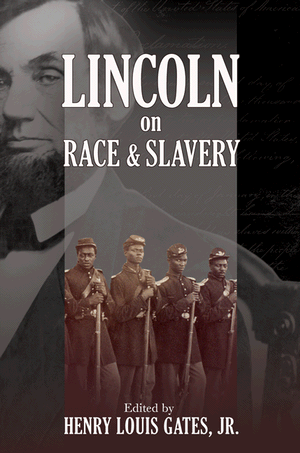
Lincoln on Race and Slavery edited by Henry Louis Gates, Jr., and Donald Yacovone (Princeton University Press, 2009, hardcover, 408 pages)

This book presents Lincoln's own words on race and slavery, offered during his life in speeches and letters. Bringing together seventy pieces that Lincoln wrote during his lifetime -- from his protest as an Illinois legislator against slavery in 1837 to his final public address on three days before his assassination in 1865 -- the book offers an introduction for each selection in addition to a general introduction by Gates.

This collection seems to mostly repackage material available in many other Lincoln anthologies. However, for someone particularly interested in this subject, the editorial context offered by the noted African-American scholar Henry Louis Gates might make this book worth owning.

Tuesday, February 3, 2009

New Lincoln Books This Week

February has arrived, so the publishers have pulled out all the stops with the Lincoln and Lincoln-related titles. Among the many new books this week, here are a few of the bigger titles.

Releasing in January

Lincoln: A Very Short Introduction by Allen C. Guelzo (Oxford University Press, US, 2009, paperback, 160 pages)

I found conflicting release dates for this book, so I've waited to write about it until this week. Among the recent spate of Lincoln biographies released have been three short biographies for adults by highly respected authors: this one by Guelzo and two released in December, one of comparable length by former senator George McGovern and an astounding one, if only for its length of only 96 pages, by James McPherson. For decades, it has been assumed that it was impossible to write a solid biography of Lincoln in around 250 pages or less. (In fact, for many years, it seemed that it was impossible to write a good biography in one volume, given prominent multi-volume biographies by writers like Carl Sandburg.) In 2002, Harvard professor William Gienapp released Abraham Lincoln and Civil War America, a concise 256 pages long, that was very well regarded by scholars and reviewers. (Personally, I was pretty underwhelmed by the effort, which seemed pretty thin to me.)

Now we have three prominent attempts to write a truly brief, but erudite, biography of Lincoln. Of these, this seems to me the most likely to be successful. McPherson and McGovern are first-time Lincoln authors, despite McPherson's career as a Civil War scholar. On the other hand, Guelzo has written an excellent full one-volume biography of Lincoln already -- Abraham Lincoln, Redeemer President. Since that book, Guelzo has focused exclusively on Lincoln with an excellent book on Lincoln and the Emancipation Proclamation, another on the Lincoln-Douglas debates and a new book on Lincoln's philosophy. If a good short biography of Lincoln is possible, Guelzo seems up to the task.

On February 3

Lincoln's Men: The President and His Private Secretaries by Daniel Mark Epstein (Collins, 2009, hardcover, 272 pages)

Daniel Epstein now offers his third Lincoln book in the last four years -- a sign of the pace this popular author maintains. All of his Lincoln books consider specific relationships of Lincoln -- the first was a parallel biography of someone who Lincoln probably never met, Walt Whitman; the second was a biography of the marriage of Abraham and Mary Lincoln. In this book (not to be confused with a previous Lincoln's Men by William C. Davis about Lincoln's relationship with the Union soldiers) Epstein traces the relationship Lincoln had with his personal secretaries in the White House.

It is difficult to overstate the depth of Lincoln's relationship with his secretaries, particularly John Nicolay and John Hay. They slept in the White House and were virtually always in the executive office; they acted as gatekeepers to Lincoln's office, they handled Lincoln's correspondence, and sometimes they even carried out missions to serve as Lincoln's eyes and ears outside the White House. They wrote on Lincoln's behalf, sometimes in his name, sometimes in anonymous articles for Union newspapers. Years after Lincoln's death, these two men would co-write a 10-volume biography of Lincoln that focused largely on his presidential years.

This book focuses on Nicolay and Hay, although it appears to also have significant material about William Stoddard, an assistant secretary who joined the team midway through the administration. Having glanced at Epstein's previous books, it will likely be a fluid narrative of these relationships. I can only hope that it does this too often overlooked topic justice.

1864: Lincoln at the Gates of History by Charles Bracelen Flood (Simon & Schuster, 2009, hardcover, 544 pages)

Flood, whose most recent book was on the relationship between Union generals Ulysses S. Grant and William T. Sherman, considers the tumultuous year of 1864 for Lincoln. At the beginning of the year, Lincoln was under tremendous pressure not to run for reelection; by the middle of the year, it seemed obvious that the Union effort was bogged down and casualty rates were growing at an alarming rate, leading even Lincoln himself to think that he would lose the fall election and the Union would perish. By year's end, or course, Lincoln has been overwhelmingly reelected and the Confederacy appears crippled.

In some ways, this seems like David McCullough's recent book 1776, which attempted to show the up-and-down fortunes of the Americans during the Revolutionary War. And, like McCullough, Flood is a strong writer who weaves his characters into a generally gripping tale. So this should be a best-selling history book. Unlike that tale, Lincoln's life is more tragic than the revolution, by the end of 1864, Lincoln's assassination is less than four months away, which I'm sure tempers Flood's retelling of the year's dramatic events.

I have mixed feelings about this book based on previous books by Flood that I've read. His Lee: The Last Years is a gripping account of Robert E. Lee's brief post-war career. But Grant and Sherman: The Friendship That Won the Civil War was only okay -- solid narrative history, but I'm not sure Flood really adequately developed the promise of his subtitle; in fairness, it could have been titled "Grant and Sherman: The Friendship That Saved Sherman's Postwar Reputation and Career," but I don't really buy that the friendship won the war from Flood's book.

Tuesday, January 27, 2009

New Lincoln Books This Week

The spate of new Lincoln books continues with two important titles this week, both companions to bicentennial Lincoln exhibits in Washington, DC. While companion books are not always brimming with new scholarship, they usually have lots of high quality photos, and as such are to be recommended.

On January 27

Abraham Lincoln: An Extraordinary Life (Smithsonian Institution Press, 2009, paperback, 128 pages)

This is the companion volume one of several Lincoln-related exhibits sponsored by the Smithsonian Institution this year. Unlike some of the other exhibits, the Smithsonian is clear that all of the artifacts in this are from the Smithsonian collection, including one of the few authentic stovepipe hats that can be proved to have been worn by Lincoln.

Here is the website for the exhibition, "Abraham Lincoln: An Extraordinary Life." This exhibit at the National Museum of American History opened earlier in January and is tentatively scheduled to be open until January 2011.

I'm looking forward to visiting this exhibit when I'm in DC next. And I imagine I will have to pick up a copy of the book, if only for the photos, as a memento.

In Lincoln's Hand: His Original Manuscripts with Commentary by Distinguished Americans, edited by Harold Holzer and Joshua Wolf Shenk (Bantam, 2009, hardcover, 208 pages)

This book is the companion of the Library of Congress upcoming exhibit: "With Malice Toward None": The Abraham Lincoln Bicentennial Exhibition, which is scheduled to open on Lincoln's birthday. (Exhibit website not available; here's the Library of Congress press release.)

This is an intriguing volume, pairing photographs of actual Lincoln documents, personally written by Lincoln, with reflections from a mixture of famous Americans and Lincoln/Civil War scholars. And it is edited by Lincoln editor extraordinaire, Harold Holzer, which means that it should be good (most of his edited stuff is). And, while I haven't seen the book, I'm sure the photographs are high quality and well lit, meaning that these items will probably be easier to read than if you were looking at them directly.

Tuesday, January 13, 2009

New Lincoln Books This Week

January tends to be the prime month to release Lincoln-specific books, and the bicentennial of Lincoln's birth has quickened the pace of publishing. This week, there are several new books being released, including these two.

On January 13

A. Lincoln: A Biography by Ronald C. White, Jr. (Random House, 2009, hardcover, 816 pages)

This is White's third book on Lincoln, following his well received books on Lincoln's Second Inaugural Address (Lincoln's Greatest Speech: The Second Inaugural) and Lincoln's speeches in general (The Eloquent President: A Portrait of Lincoln Through His Words). I have read the first, but not the second. While White seems to have been accepted by most of the prominent Lincoln scholars, I found the first book underwhelming -- I was disappointed because I just don't think White's analysis of Lincoln's Second Inaugural matched the depth of Lincoln's writing.
Perhaps this biography is a worthy addition to the Lincoln bookshelf, but I would be more likely to recommend other new biographies: long (2000+ pages) by Michael Burlingame or short (less than 100) by James McPherson.

On January 15

Abraham Lincoln in the Post-Heroic Era: History and Memory in Late Twentieth Century America by Barry Schwartz (University of Chicago Press, 2009, hardcover, 410 pages)

This is the second volume of Schwartz' two-part look at the history of Lincoln's reputation since his assassination. The first book (Abraham Lincoln and the Forge of National Memory) covered the period from 1865-1920, while the new book documents the years from 1920 to the present.

I am excited to see Schwartz' new book. Currently, Merrill Peterson's Lincoln in American Memory is the standard about the impact and means of Lincoln's legacy since his assassination. Schwartz, who specializes in cultural memory, focuses his analysis more narrowly than Peterson by looking to see the meaning of Lincoln in American memory, rather than chronicling the manifestations of Lincoln's legacy.

Abraham Lincoln and the Forge of National Memory was an intriguing exploration of Lincoln's place in American cultural memory. While I think that Schwartz misrepresents Lincoln's reputation during his presidency (like many, he too easily buys into the argument that the unpopular Lincoln became a legend by being assassinated), the rest of his analysis is solid.